

Learning basic Spanish is a must when going on this assignment to Panama. This is crucital knowledge for business interactions as well as day to day life while in Panama. These lessons will help you be able to communicate on a basic level to get your point across.
Below are videos providing basic Spanish lessons. Be sure to watch the videos and practice outloud as you follow along. After each video take the lesson assessment and jot down any notes to discuss with the trainer at the end of the week.
Spanish Lesson 1: This video will cover greetings and introductions. Be sure to watch and practice outloud with the video.
Spanish Lesson 3: This lesson will include learning about food.
Spanish Lesson 2: This lesson will cover personal descriptions.
LANGUAGE
Click here to take spanish quiz #3
Click here to take spanish quiz #2
Click here to take spanish quiz #1

Religious Beliefs:
Panama is 85 percent Roman Catholic. Traditional beliefs and practices have been maintained among the native American groups despite a history of missionization.
Rituals and Holy Places:
The most important ritual is Carnaval. The capital closes down the five days before Ash Wednesday, and a young queen chosen by charitable organizations presides. A competing "more authentic" celebration takes place in Las Tablas in the interior. Coastal blacks celebrate the Congo, which starts in January and also is presided over by a queen in each community. Its male and female dance groups perform each weekend. The colonial port city of Potrobelo on the Atlantic coast is the site of a shrine to an icon of the Black.
Still, for all its diversity, Panama’s dominant culture has Spanish origins. The family is all-important, Catholicism is prominent, and machismo is a way of life for most men. The U.S. has also had a large influence in Panama, due to its long presence in the country. It’s not uncommon to see people wearing American clothes or listening to music from the U.S., especially within Panama City.
The extended family is the most important social unit in Panama. People work hard to take care of their relatives and are quick to tell you about the achievements of those they are related to.
Children are raised by their extended family and genuinely respect their elders.
Panamanians often live at home well into their twenties and thirties, or at least until they get married. Family-oriented occasions, including birthdays, Mother’s day, and baptisms, are important, and families often travel together.
Importance is placed on personal appearance and hygiene. Panamanians try to maintain a neat, conservative appearance when in public. Generally, men pair long pants with a collared shirt; shorts and sandals are usually considered too casual. For women, a dress or jeans paired with a nice top is appropriate. It should also be noted that it is illegal for men or women to walk around a city or town without a t-shirt. Being shirtless on a beach is fine, but try to wear something while walking through town, as this law is actually enforced.
Tranquilo is a word that you may come across while traveling in Panama. It means calm or peaceful and can be applied to a person, place or a situation. It’s also a good example of the Panamanian perception of time.
CULTURE
Click here to take assessment #2

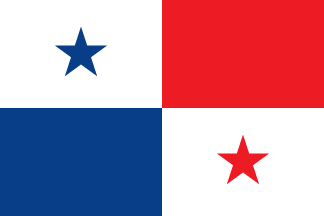
República de Panamá