

Panama’s Labor Force:
Occupation:
- Government and community services 31.8%
- Agriculture, hunting, and fishing 26.8%
- Commerce, restaurants, and hotels 16.4%
- Manufacturing and mining 9.4%
- Construction 3.2%
- Transportation and communications 6.2%
- Finance, insurance, and real estate 4.3%
Note: There is shortage of skilled labor, but an surplus of unskilled labor.
United States Business Policies:
The United States and Panama entered a Panama Trade Promotion Agreement on October 31, 2012. The TPA and has significantly loosened the trade in goods and services, including financial services. The TPA also includes a section on customs administration and trade facilitation which ultimately reduces trade barriers. This agreement also strengthened telecommunications, electronic commerce, intellectual property rights, and labor and environmental protection.
Click here to take assessment #1
BASIC OVERVIEW
About Panama:
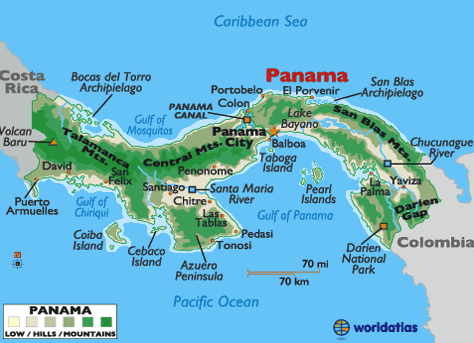
Panama is the southernmost country in Central America and is the second largest fasting growing economy in CA. Panama they have a total population upwards of 3,500,000 citizens and a demographic growth rate of 1.56%. The once Spanish colony shares a diverse background of Spanish, Native American, and African descent. Panama lies on the Isthmus of Panama and links Central and South America. Panama’s neighbor countries are Costa Rica and Colombia. The famous Panama Canal divides the country to provide a water passage for sea vessels traveling between the Caribbean and Pacific Oceans. The capital of Panama is Panama City.
Panama enjoys a yearlong tropical climate consisting of dry heat and humid showers. Panama has remained a top tourist destination as well as a great place of doing business. Until the year 2000, the United States had control of the Panama Canal which stimulated international trade as well as the movement of American people to this location. People are attracted to this location because of its industries of banking, commerce, and tourism as well as the climate and easy-going lifestyle.

Government, Relevant Laws, and Regulations:
Because of its key geographic location, Panama's economy is mostly service based. Panama’s global and regional reputation is being enhanced by recent trade liberalization, privatization, and movement toward free trade agreements. The Panama Canal and other shipping and port activities are currently the country’s main drivers of growth and represent a significant portion of GDP.
Panama's US dollar-based economy offers low inflation in compared to its neighboring countries and therefore has a zero foreign exchange risk. Its government is stable and democratic and actively seeks foreign investment in all divisions, especially services. Panama joined the World Trade Organization and has approved a tariff reduction that will give the country one of the lowest average tariff rates in its region.
A banking reform law was also approved to commercialize banking systems and stimulate economic growth. Panama has no legal restrictions on the transfer abroad of funds associated with or capital involved with investments. There are also no restrictions on capital outflows or any conversion rates.
The Government of Panama is also in the midst of a $15 billion infrastructure investment plan scheduled to end in 2014. The effort includes a $2 billion metro line and other significant improvements to Panama’s transportation infrastructure.


República de Panamá